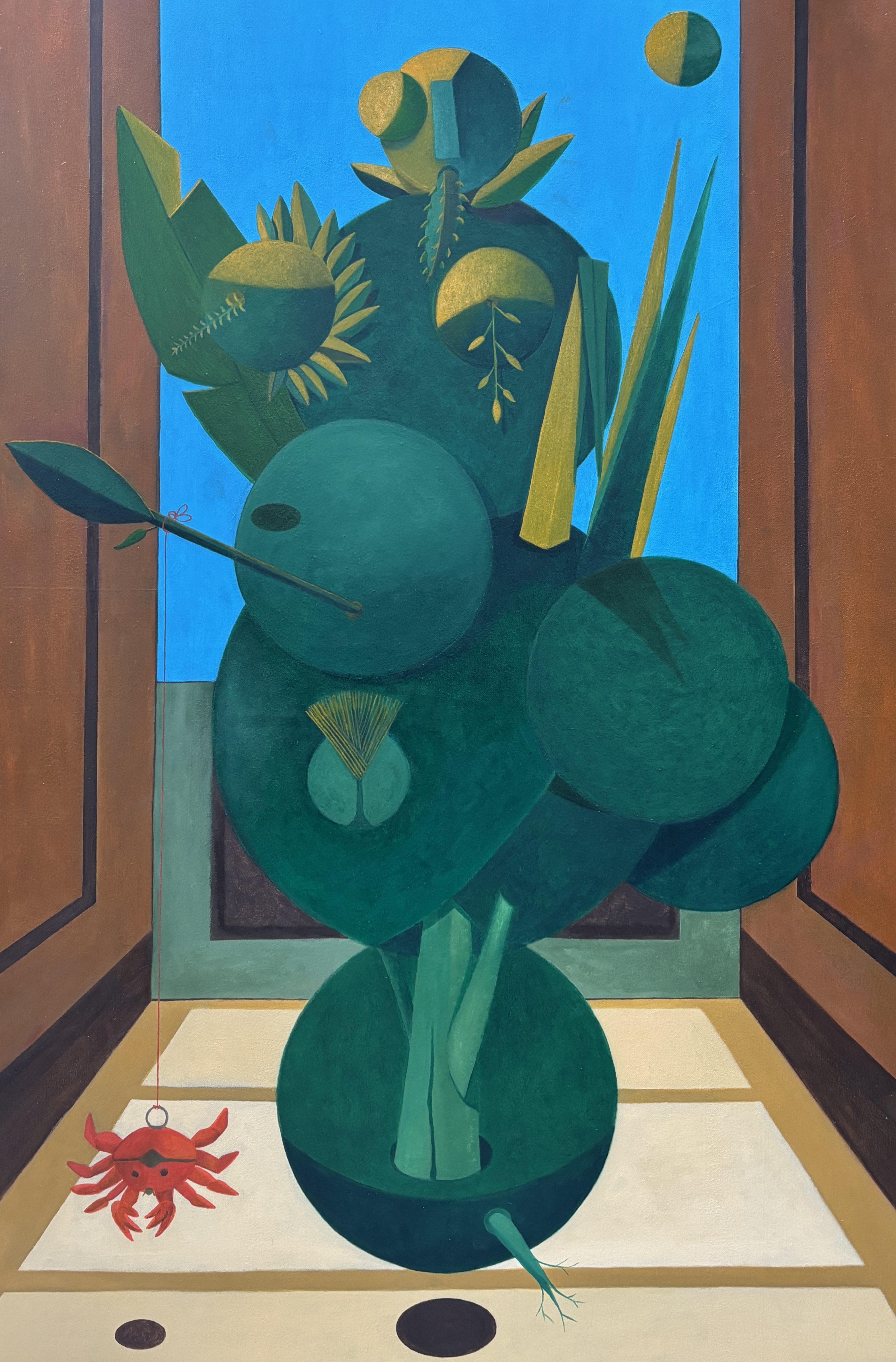
EN – The figure, composed of vegetal spheres, follows a modular logic that evokes both organic growth and conceptual assembly. This hybridisation between nature and structure produces a body without traditional anatomy, yet endowed with internal coherence — a constructed organism, almost architectural.
The surrounding space, defined by a linear perspective reminiscent of Renaissance architecture, establishes a rational framework that contrasts with the vegetal logic of the figure. This tension between geometric order and organic proliferation situates the form in an in‑between state: mental construction and raw vitality.
The elements emerging from the body function as symbolic operators. The branches bursting from the chest evoke a nourishing imaginary, materialising a vital flow and a primordial transmission. The spear emerging from the navel forms the central axis of the composition: a vector of energy, a principle of projection, introducing a warrior‑like posture within a body built from soft, spherical forms.
The crab suspended from a red thread, held at a distance at the end of a branch, condenses two symbolic registers — the astrological sign of Cancer and the evocation of illness. Its suspension stages a fragile form of control, precarious yet real. The red thread acts as a marker of vital tension, a link between the figure and its shadow.
At the base, a root introduces a dimension of grounding. It refers to an underground memory, to what persists beyond visibility, balancing the vertical axis of the spear and inscribing the figure within a deep continuity.
The whole articulates a reflection on identity construction, bodily memory, and the coexistence of contradictory forces: nourishing and fighting, growing and resisting, rising and rooting. The figure appears as a symbolic territory traversed by vital dynamics and suspended threats, within an aesthetic combining contemporary surrealism, geometric symbolism, and neo‑conceptualism.
FR – La figure, composée de sphères végétales, s’inscrit dans une logique modulaire qui évoque à la fois la croissance organique et l’assemblage conceptuel. Cette hybridation entre nature et structure produit un corps sans anatomie traditionnelle, mais doté d’une cohérence interne : un organisme pensé, presque architecturé.
L’espace environnant, défini par une perspective linéaire d’inspiration renaissante, instaure un cadre rationnel qui contraste avec la logique végétale du personnage. Cette tension entre ordre géométrique et prolifération organique place la figure dans un entre‑deux : construction mentale et vitalité brute.
Les éléments qui émergent du corps fonctionnent comme des opérateurs symboliques. Les branches jaillissant de la poitrine renvoient à un imaginaire nourricier, matérialisant un flux vital et une transmission première. La lance issue du nombril constitue l’axe central de la composition : vecteur d’énergie, principe de projection, elle introduit une posture guerrière au sein d’un corps fondé sur des formes douces et sphériques.
Le crabe suspendu à un fil rouge, tenu à distance au bout d’une branche, condense deux registres symboliques — le signe astrologique du Cancer et l’évocation de la maladie. Sa suspension met en scène une maîtrise fragile, un contrôle précaire mais réel. Le fil rouge agit comme un marqueur de tension vitale, un lien entre la figure et son ombre.
À la base, une racine introduit une dimension d’ancrage. Elle renvoie à une mémoire souterraine, à ce qui persiste en dehors du visible, équilibrant l’axe vertical de la lance et inscrivant la figure dans une continuité profonde.
L’ensemble articule une réflexion sur la construction identitaire, la mémoire corporelle et la coexistence de forces contradictoires : nourrir et combattre, croître et résister, s’élever et s’enraciner. La figure apparaît comme un territoire symbolique traversé par des dynamiques vitales et des menaces suspendues, dans une esthétique mêlant surréalisme contemporain, symbolisme géométrique et néo‑conceptualisme.
LU – D’Figur, aus vegetalesche Kugelen opgebaut, follegt enger modulärer Logik, déi gläichzäiteg un organesche Wuesstem an un eng konzeptuell Zesummesetzung erënnert. Dës Hybriditéit tëscht Natur a Struktur schaaft e Kierper ouni traditionell Anatomie, awer mat enger eegener Kohärenz — en duerchduechte, bal architektonesche Organismus.
De Raum ronderëm, definéiert duerch eng linear Perspektiv mat Renaissance‑Referenzen, setzt e rationalen Kader, deen am Kontrast zur vegetaler Logik vun der Figur steet. Dës Spannung tëscht geometrescher Uerdnung an organescher Prolifératioun plazéiert d’Form an engem Zwëschenzoustand: gedanklech Konstruktioun a vital Energie.
D’Elementer, déi aus dem Kierper ervirkommen, funktionéieren als symbolesch Operatoren. D’Äscht, déi aus der Broscht sprangen, verweisen op en nährenden Ursprongsbild a materialiséieren e liewensspendende Flux. D’Lanz, déi aus dem Nabel ervirgeet, formt den zentrale Längsachs vun der Kompositioun: en Energie‑Vektor, e Prinzip vun der Projektioun, an eng Haltung déi un eng Kriegerin erënnert.
De Krab, um roude Fuedem hänkend an um Enn vun engem Aascht op Distanz gehalen, kondenséiert zwee symbolesch Regëster — dat astrologescht Zeeche Cancer an d’Evokatioun vun enger Krankheet. Seng Suspensioun weist eng fragil, awer reell Form vu Kontroll. De roude Fuedem markéiert eng vital Spannung, eng Verbindung tëscht der Figur an hirem Schied.
Ënnen drënner bréngt eng Wuerzel eng Dimensioun vum Verankeren eran. Si verweist op eng ënnerierdesch Erënnerung, op dat wat ausserhalb vum Siichtbare bestoe bleift, an equilibréiert den axialen Impuls vun der Lanz.
D’Kompositioun reflektéiert d’Konstruktioun vun Identitéit, d’kierperlech Erënnerung an d’Koexistenz vu géigesätzleche Kräfte: ernären a kämpfen, wuessen a widderstoen, sech erhiewen a sech verankeren. D’Figur erschéngt als symbolescht Territoire, duerchzu vun vitalen Dynamiken a suspendéierte Bedrohungen, an enger Ästhetik déi moderne Surrealismus, geometresche Symbolismus an Neo‑Konzeptualismus vereent.

Le jardin flottant
Dimensions 80×120 cm