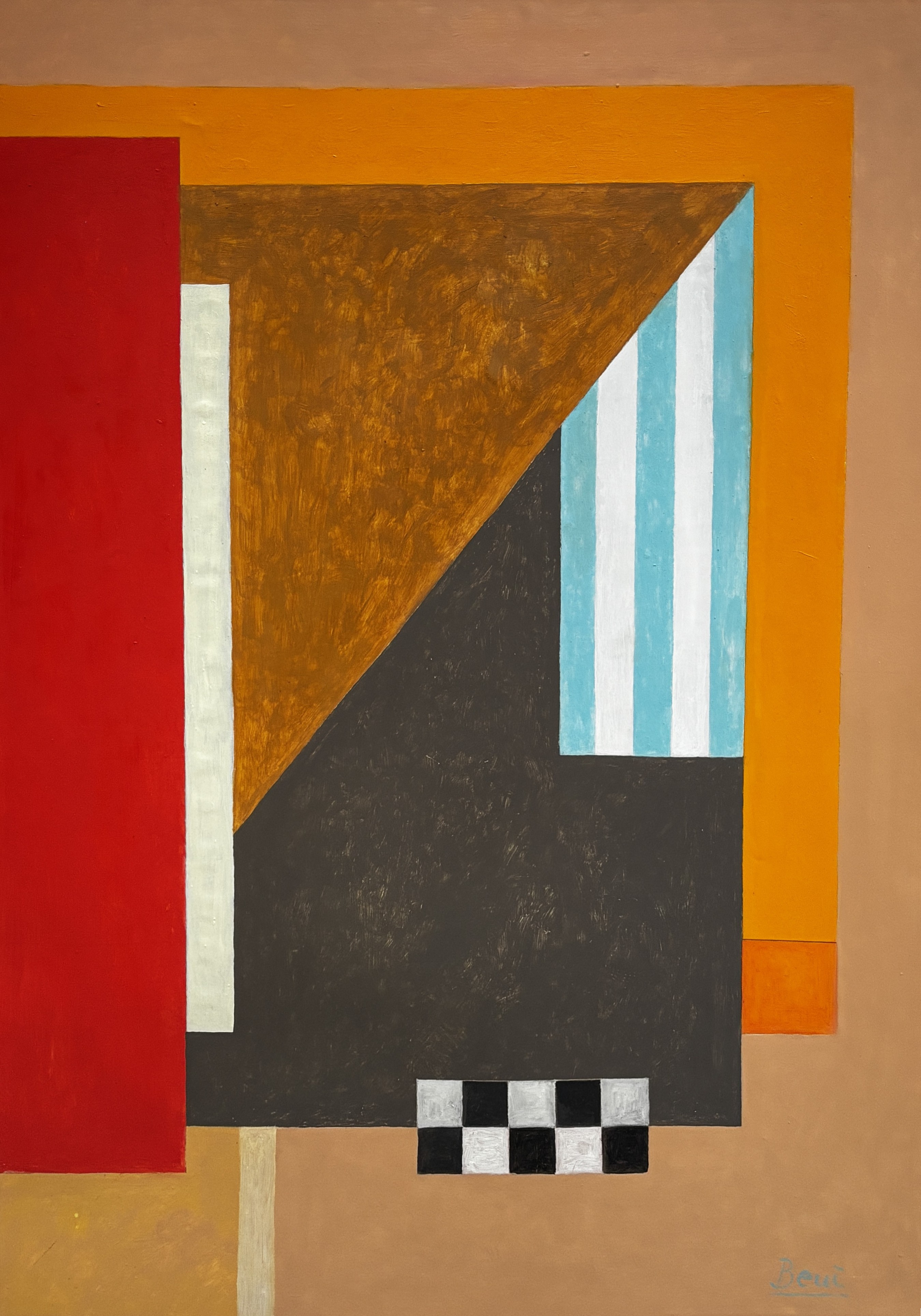
EN – In this work, the human face seen in profile is constructed through a refined geometric vocabulary. An ochre triangle represents the hair, while an orange band suggests the bridge of the nose, drawing a vertical line that structures the profile. A warm grey surface outlines the silhouette of the face, reduced to an essential, almost symbolic form.
The blue and white bands represent tears, translating emotion into a graphic rather than naturalistic language. Their presence introduces a sensitive dimension within a composition built on formal rigor.
The tension between warm colors—red, orange, ochre—and cooler tones—blue, grey, black, white—structures the pictorial space. The checkerboard pattern at the bottom of the canvas adds visual dynamism that contrasts with the gravity of the weeping face.
The work questions the ability of abstraction to convey emotion. Here, sorrow is coded, organized, absorbed into geometric logic. The viewer is invited to read these tears as a passage between pure form and intimate experience.
FR – Dans cette œuvre, le visage humain vu de profil se construit à partir d’un vocabulaire géométrique épuré. Un triangle ocre figure les cheveux, tandis qu’une bande orange évoque l’arête du nez, traçant une ligne verticale qui organise le profil. Une surface gris chaud dessine la silhouette du visage, réduite à une forme essentielle, presque symbolique.
Les bandes bleu et blanc représentent les larmes, traduisant l’émotion dans un langage graphique plutôt que naturaliste. Leur présence introduit une dimension sensible au sein d’une composition fondée sur la rigueur formelle.
La tension entre couleurs chaudes — rouge, orange, ocre — et tonalités froides — bleu, gris, noir, blanc — structure l’espace pictural. Le damier en bas de la toile ajoute une dynamique visuelle qui contraste avec la gravité du visage en pleurs.
L’ ’œuvre interroge la capacité de l’abstraction à accueillir l’émotion. Ici, la douleur est codée, organisée, absorbée par la logique géométrique. Le spectateur est invité à lire ces larmes comme un passage entre la forme pure et l’expérience intime.
LU – An dësem Wierk gëtt d’mënschlecht Gesiicht am Profil aus engem reduzéierte geometresche Vokabulaire opgebaut. En ockerfaarwege Dräieck stellt d’Hoer duer, wärend eng orangefaarweg Band d’Nuesbréck erahne léisst an eng vertikal Linn zitt, déi de Profil strukturéiert. Eng waarm gro Fläch zeechent d’Silhouette vum Gesiicht, reduzéiert op eng essentiell, bal symbolesch Form.
Déi blo a wäiss Bänner stellen d’Tréinen duer an iwwersetzen d’Emotioun an eng grafesch, net naturalistesch Sprooch. Hir Präsenz bréngt eng sensibel Dimensioun an eng Kompositioun, déi op formaler Strengheet baséiert.
D’Spannung tëscht waarme Faarwen — rout, orange, ocker — an de killen Téin — blo, gro, schwaarz, wäiss — strukturéiert de bildleche Raum. D’Schachbrietmuster um ënneschten Deel vun der Leinwand bréngt eng visuell Dynamik, déi am Kontrast zur Schwéier vum trauernde Gesiicht steet.
D’Wierk stellt d’Fro, wéi wäit Abstraktioun Emotioun droe kann. Hei gëtt de Schmerz codéiert, organiséiert an an déi geometresch Logik integréiert. De Betrachter gëtt invitéiert, dës Tréinen als Iwwergang tëscht reiner Form an intimer Erfarung ze liesen.

Le pleur
Dimensions 50×70 cm