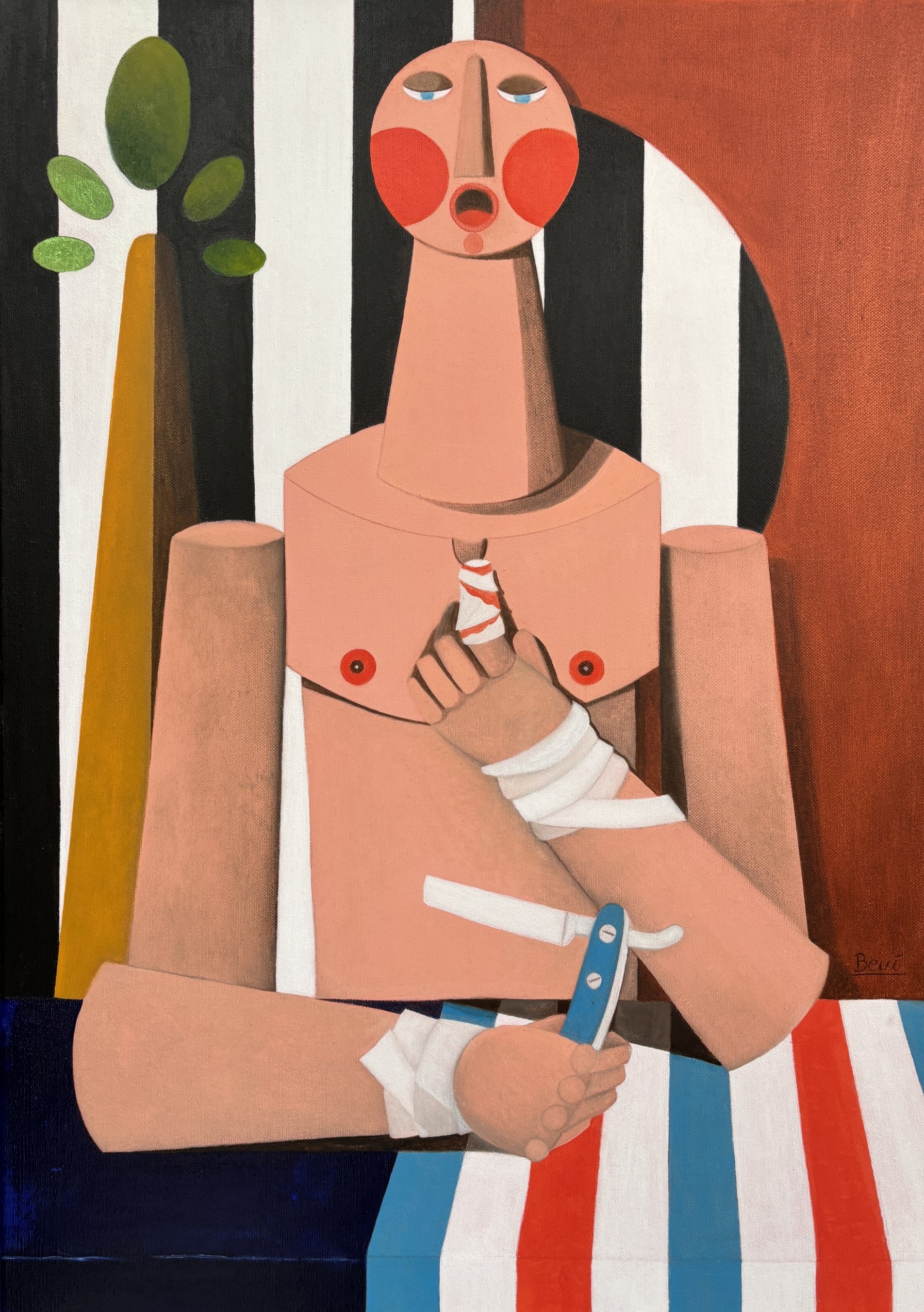
EN – In Le Barbier, the stylized figure adopts the posture of a contemporary martyr saint. The razor, normally a tool of care, becomes an instrument of suffering. The wrists wrapped in a clean bandage, revealing nothing, while the raised finger — also bandaged, marked by a thin trace of blood — points to the visible wound as if to conceal a deeper, unspoken one. This ambiguous, almost liturgical gesture echoes classical depictions of martyrdom, where pain becomes a form of revelation. In the background, the palm‑like plant reinforces this symbolic reading, recalling the traditional emblem of saints who endured suffering. The barber’s tricolour cloth introduces a tension between professional ritual and intimate sacrifice. Through its geometric construction and frontal composition, the work draws on Cubism, Purism, and Constructivism, translating sacred iconography into a modern visual language.
FR – Dans Le Barbier, la figure stylisée adopte la posture d’un saint martyr transposé dans un langage plastique moderne. Le personnage tient une lame de rasoir, instrument du soin devenu instrument du supplice. Les poignets bandés, sans trace de sang, suggèrent une blessure plus profonde, tue, tandis que le doigt levé — lui aussi bandé, marqué d’une fine coulure rouge — semble désigner la blessure visible pour mieux masquer celle qui ne l’est pas. Ce geste ambigu, presque liturgique, renvoie aux représentations classiques du martyre où la douleur se double d’une révélation intérieure. À l’arrière‑plan, la plante évoquant une palme renforce cette lecture iconographique, rappelant l’attribut traditionnel des saints martyrs. La nappe aux couleurs distinctives des barbiers introduit une tension entre rituel professionnel et sacrifice intime. Par sa construction géométrique et sa frontalité, l’œuvre s’inscrit dans les esthétiques du cubisme, du purisme et du constructivisme, réinterprétant la tradition sacrée dans une grammaire visuelle résolument contemporaine.
LU – Am Le Barbier hëlt d’Figur d’Haltung vun engem modernen Mäerteeler‑Hellegen un. D’Raséiermesser, normalerweis en Outil vun der Fleeg, gëtt hei zum Instrument vum Leed.
D’Handgelenker si propper verbannen, ouni Blutt, wat op eng méi déif, onsichtbar Wonn hiweist. De gehuewene Fanger — och verbannen a mat enger klenger Bluttspur — weist op déi sichtbar Verletzung, fir déi verstoppt, méi schwéier Wonn ze ënnersträichen. Dëse gestesch zweedeitege Moment erënnert un déi klassesch Duergestellunge vum Mäerteelertum, wou Schmerz an Offenbarung zesummelafen.
Am Hannergrond steet eng Planz, déi un eng Palem erënnert — dat traditionellt Symbol vun de Mäerteeler. D’Duch mat de charakteristesche Faarwe vun de Barbiere schaaft eng Spannung tëscht Ritual an Affer.
Duerch seng geometresch Konstruktioun an déi frontal Kompositioun orientéiert sech d’Wierk un kubisteschen, puristeschen an konstruktivisteschen Ästhetiken, an iwwersetzt déi helleg Ikonographie an eng modern Formesprooch.

Le barbier
Dimensions 50×70 cm