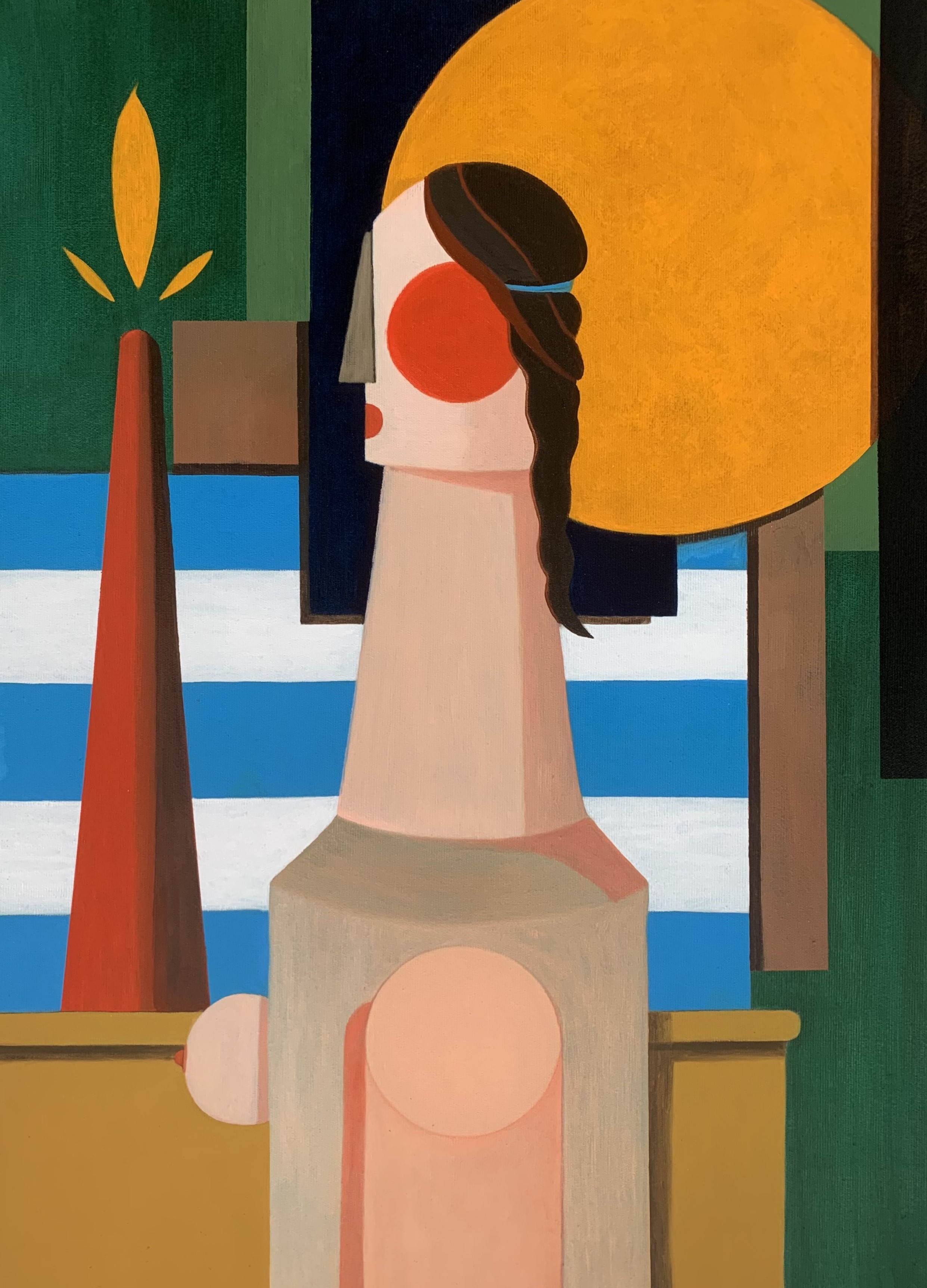
EN – This portrait directly responds to Battista Sforza, Duchess of Urbino, as depicted by Piero della Francesca in the celebrated Quattrocento diptych. Where her profile conveys silent presence, stability, and inner radiance, this contemporary reinterpretation translates that dignity into a geometric and symbolic language.
The figure, constructed through strict geometry, occupies a space where human and vegetal forms intersect. A stylised trunk rises in the foreground, crossing in front of the face, while a golden disc unfolds behind the head, functioning as an abstract canopy. This layering reverses the logic of the traditional halo: light no longer surrounds the figure, it belongs to the landscape.
The blue and white bands articulate the background as a sequence of atmospheric planes, giving the figure an open, almost suspended environment. Their alternation creates a quiet depth that contrasts with the assertive presence of the trunk in the foreground. The figure does not emerge from a setting; it appears held within a field of forces where verticality and horizontality find equilibrium, imparting a meditative quality to the portrait.
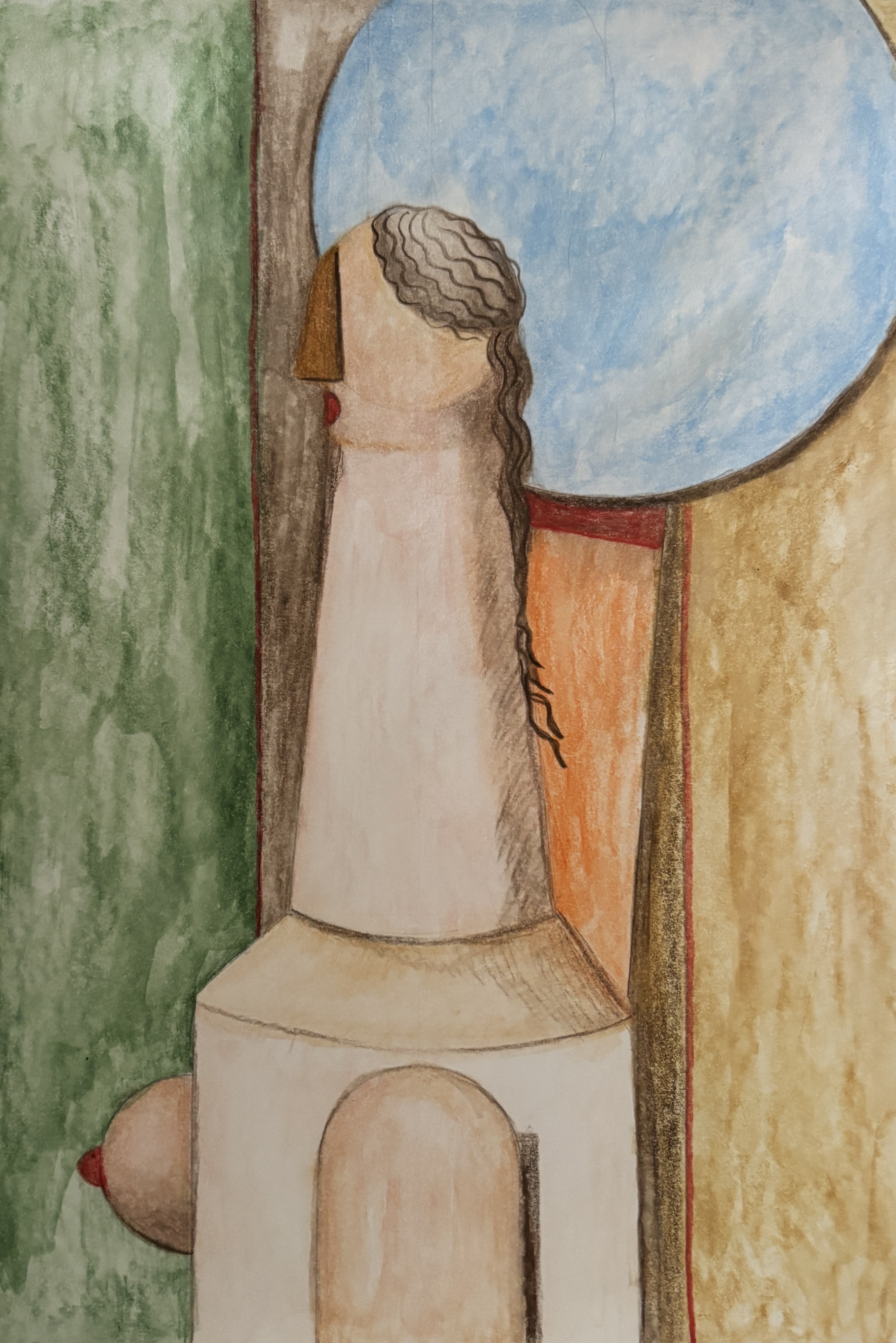
The work stands at the intersection of Italian Quattrocento, Constructivism, Purism, and a form of Neo‑Iconism that revisits the monumentality of Renaissance portraiture. It forms a diptych with Profile (m) in a Modern Interior. The landscape lines meet those of the companion canvas, creating a visual continuity that binds both profiles within a shared mental space.
FR – Ce portrait répond directement à celui de Battista Sforza, la Duchesse d’Urbino, telle que représentée par Piero della Francesca dans le célèbre diptyque du Quattrocento. Là où le profil de la duchesse incarne une présence silencieuse, stable et lumineuse, cette relecture contemporaine transpose cette dignité dans un langage géométrique et symbolique.
La figure, construite selon une géométrie stricte, s’inscrit dans un espace où l’arbre et l’humain se confondent. Un tronc stylisé se dresse au premier plan, passant devant le visage, tandis qu’un disque doré se déploie en arrière‑plan, derrière la tête, comme une canopée abstraite. Cette superposition renverse la logique du halo traditionnel : la lumière n’entoure plus la figure, elle appartient au paysage.
Les bandes bleues et blanches structurent l’arrière‑plan comme une succession de plans atmosphériques, donnant à la figure un espace ouvert, presque suspendu. Leur alternance crée une profondeur calme qui contraste avec la présence affirmée du tronc au premier plan. La figure ne se détache pas d’un décor : elle semble prise dans un champ de forces où verticalité et horizontalité s’équilibrent, conférant à l’ensemble une dimension méditative propre à ce portrait.
L’œuvre se situe à la croisée du Quattrocento italien, du constructivisme, du purisme et d’un néo‑iconisme qui revisite la monumentalité du portrait renaissant. Elle forme un diptyque avec Profil (m) dans un intérieur moderne. Les lignes du paysage rejoignent celles de l’autre toile, créant une continuité visuelle qui unit les deux profils dans un même espace mental.
LU – Dëst Portrait äntwert direkt op Battista Sforza, d’Herzogin vun Urbino, esou wéi si am berühmte Quattrocento‑Diptychon vum Piero della Francesca duergestallt gëtt. Do wou hire Profil eng roueg Präsenz, Stabilitéit an eng bannenzeg Liichtkeet ausdréckt, iwwersetzt dës modern Neiinterpretatioun déi selwecht Dignitéit an eng geometresch a symbolesch Sprooch.
D’Figur, no enger strenger geometrescher Logik opgebaut, steet an engem Raum, wou mënschlech a vegetalesch Formen openee treffen. E stiliséierte Stamm zitt sech am Virdergrond virun d’Gesiicht, wärend am Hannergrond e gëllene Krees hannert dem Kapp opdämpt an eng abstrakt Canopée formt. Dës Iwwerleeung keert d’Logik vum traditionelle Halo ëm: d’Liicht ëmfaasst d’Figur net méi, mee gehéiert zum Landschaftsraum.
Déi blo‑wäiss Sträifen glidderen den Hannergrond wéi eng Reiefolleg vu Loftschichten a ginn der Figur en oppenen, bal schwebende Raum. Hir Ofwiesslung schaaft eng roueg Déift, déi am Géigesaz zur markanter Präsenz vum Stamm am Virdergrond steet. D’Figur entsteet net aus engem Dekor; si schéngt an engem Feld vu Kräfte verankert ze sinn, wou Vertikalitéit an Horizontalitéit an d’Gläichgewiicht kommen an dem Portrait eng meditativ Dimensioun ginn.
D’Aarbecht steet tëscht dem italienesche Quattrocento, dem Konstruktivismus, dem Purismus an enger Form vu Neo‑Iconismus, déi d’Monumentalitéit vum Renaissance‑Portrait nei interpretéiert.Dëst Wierk bildt e Diptychon zesumme mat Profil (m) an engem moderne Raum. D’Landschaftslinnen treffen déi vun der anerer Leinwand a schafen eng visuell Kontinuitéit, déi déi zwee Profilen an engem gemeinsame gedankleche Raum verbënnt.

Profil (f) dans un intérieur moderne.
Dimensions 50×70 cm