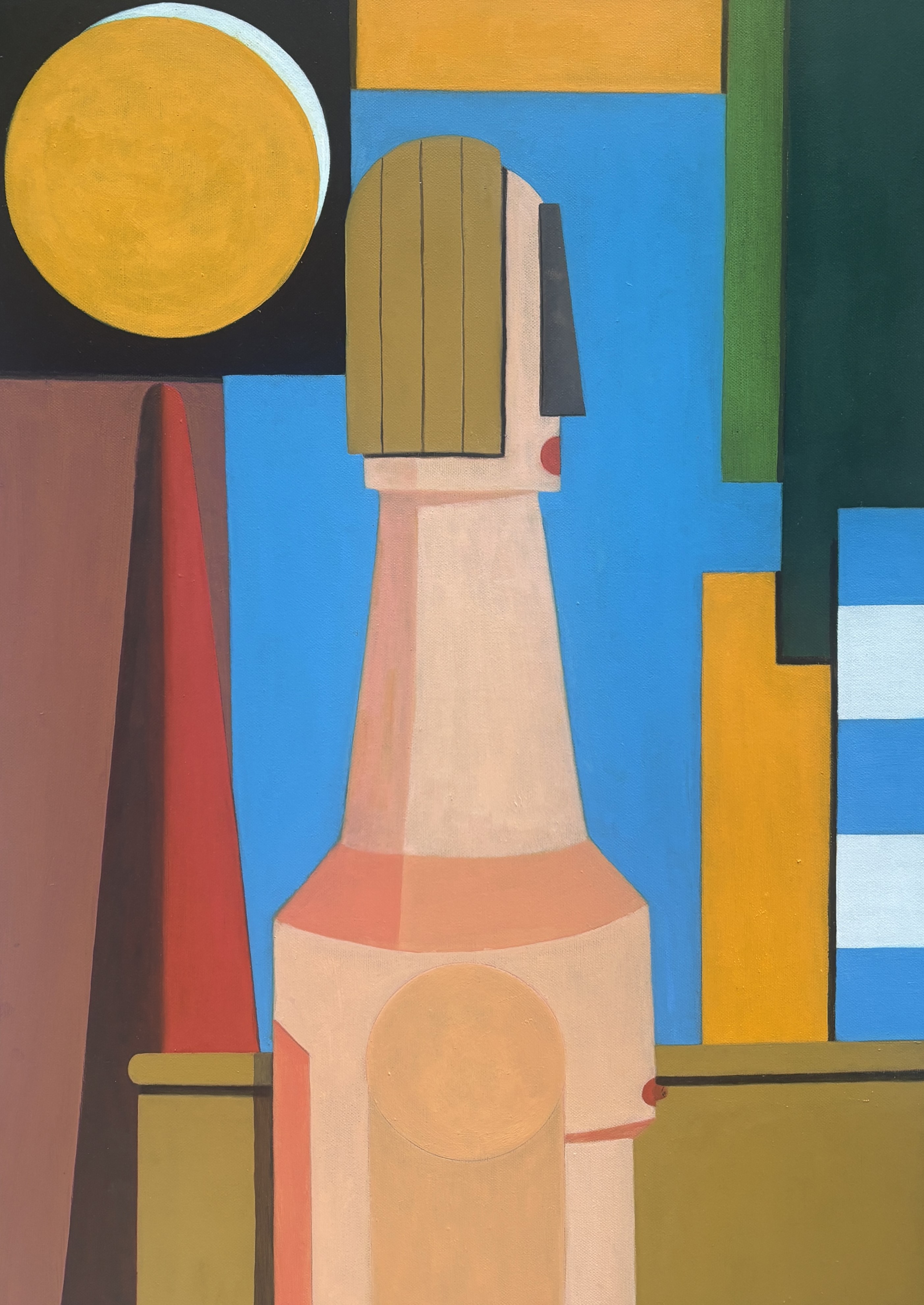
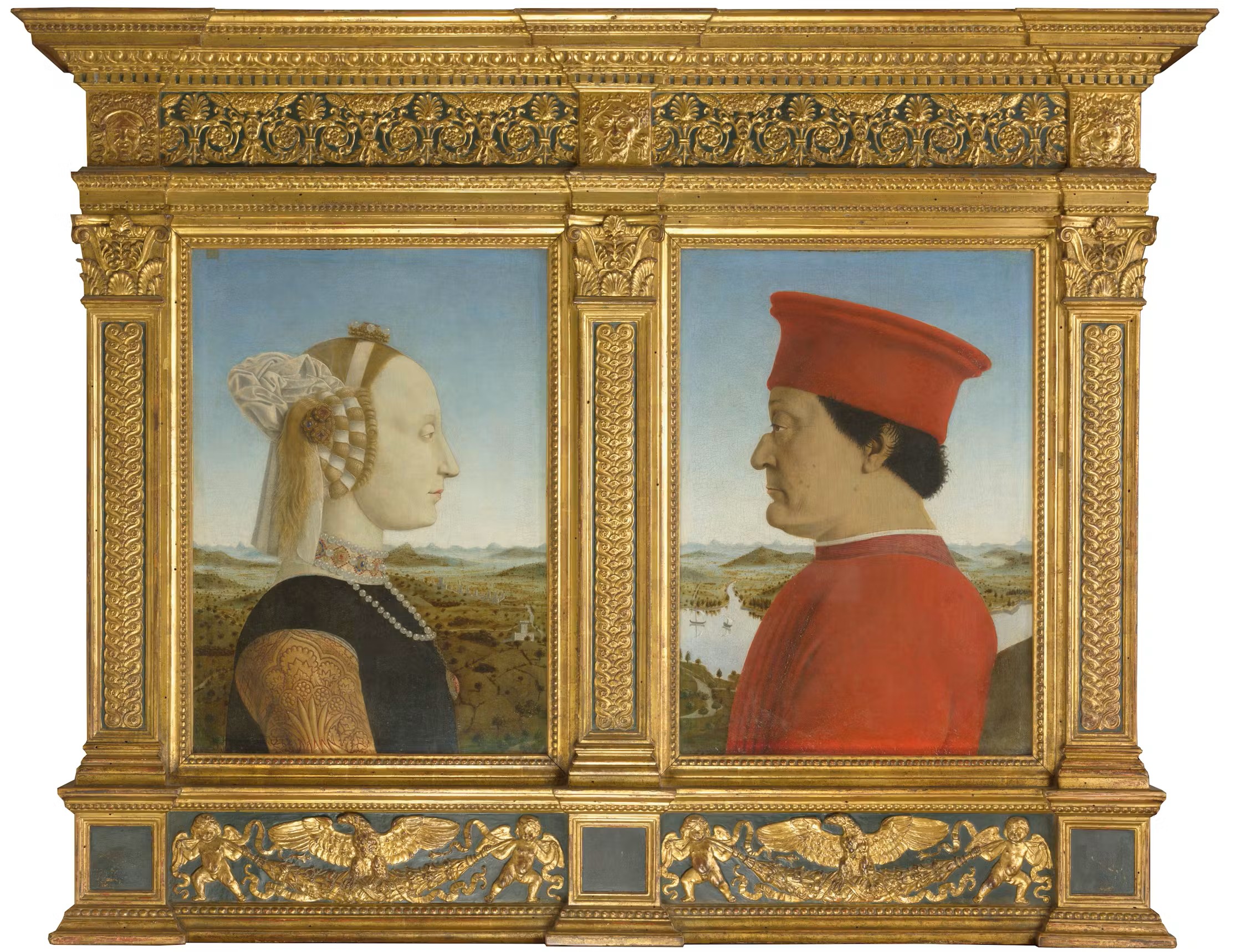
EN – The figure is built through a strict geometric logic in which each form — circle, rectangle, stripe, coloured plane — contributes to a contemporary reinterpretation of the Renaissance profile. Inspired by Piero della Francesca’s Portrait of the Duke of Urbino, the composition retains the frontal solemnity of the Quattrocento while translating it into an abstract, structural language.
Behind the face, a vertical trunk rises and expands into a golden disc forming the crown of the tree. This tree‑crown ensemble acts as an axis of growth, replacing the architectural column traditionally associated with Renaissance portraiture. The disc, far from a religious halo, functions as a stylised canopy — a solar form that anchors the figure within a long, organic temporality.
The landscape, fully geometrised, unfolds in coloured strata that evoke both a mental topography and a stylised real space. The blue‑and‑white bands introduce a horizontal rhythm reminiscent of a maritime horizon or segmented sky. This radical simplification reinforces the timelessness of the scene and transforms the setting into a system rather than a location.
The work articulates a reflection on the construction of the face as architecture, on the integration of vegetal elements into human representation, and on the persistence of Quattrocento models within contemporary art. It stands at the intersection of Italian Quattrocento, Constructivism, Purism, and a form of neo‑iconism that revisits the codes of frontal and monumental representation.
FR – La figure est construite selon une logique géométrique stricte, où chaque forme — cercle, rectangle, bande, plan coloré — participe à la relecture contemporaine du profil renaissant. Inspirée du Portrait du Duc d’Urbino de Piero della Francesca, la composition reprend la frontalité du Quattrocento tout en la transposant dans un langage abstrait et structurel.
Derrière le visage, un tronc vertical s’élève et se prolonge dans un disque doré qui en constitue la couronne. Cet ensemble arbre‑couronne agit comme un axe de croissance, un principe d’élévation qui remplace la colonne architecturale traditionnelle. Le disque, loin d’un halo religieux, fonctionne comme une canopée stylisée : une forme solaire qui inscrit la figure dans une temporalité longue et dans une continuité organique.
Le paysage, entièrement géométrisé, se déploie en strates colorées qui évoquent autant une topographie mentale qu’un espace réel. Les bandes bleues et blanches instaurent un rythme horizontal rappelant un horizon maritime ou un ciel segmenté. Cette réduction extrême du paysage renforce l’intemporalité de la scène et fait du décor un système plutôt qu’un lieu.
L’ensemble articule une réflexion sur la construction du visage comme architecture, sur l’intégration du végétal dans la représentation humaine, et sur la persistance des modèles du Quattrocento dans la création contemporaine. L’œuvre se situe à la croisée du Quattrocento italien, du constructivisme, du purisme et d’un néo‑iconisme qui revisite les codes de la frontalité et de la monumentalité.
LU – D’Figur ass no enger strenger geometrescher Logik opgebaut, wou all Form — Krees, Rechteck, Sträif, faarwege Plang — zu enger moderner Neiinterpretatioun vum renaissancistesche Profil bäidréit. Inspiréiert vum Portrait vum Herzog vun Urbino vum Piero della Francesca, iwwerhëlt d’Kompositioun d’Frontalitéit vum italienesche Quattrocento, iwwersat an eng abstrakt a strukturell Sprooch.
Hannert dem Gesiicht geet e Baamstamm an d’Luucht a leeft an engem gëllene Krees aus, deen d’Kroun vum Bam duerstellt. Dëse Bam‑Kroun‑Ensemble ersetzt déi architektonesch Kolonn, déi dacks mat Renaissance‑Portraiten verbonne gëtt, a verankert d’Figur an enger laanger, organescher Zäit. De gëllene Krees ass kee reliéise Halo, mee eng stiliséiert Kroun, eng sonneg Form mat enger stabiliséierender Funktioun an der Kompositioun.
D’Landschaft, komplett geometresch reduzéiert, entfaalt sech an faarwege Schichten, déi gläichzäiteg un eng mental Topographie an un eng stiliséiert Realitéit erënneren. Déi blo‑wäiss Sträifen schafen en horizontalen Rhythmus, wéi en Mier‑ oder Himmels‑Horizont. Dës staark Reduktioun verstäerkt d’Zeitlosegkeet an transforméiert d’Kuliss an e System amplaz vun engem konkrete Raum.
D’Aarbecht reflektéiert d’Konstruktioun vum Gesiicht als Architektur, d’Integratioun vum Vegetalen an d’mënschlech Representatioun, an d’Persistenz vun de Modeller vum Quattrocento an der aktueller Konscht. Si steet tëscht italieneschem Quattrocento, Konstruktivismus, Purismus an enger Form vu Neo‑Iconismus, déi d’Regele vun der frontaler a monumentaler Duerstellung nei interpretéiert.

Profil (m) dans un intérieur moderne.