EN – On 29 and 30 April 2026, a humanitarian flotilla en route to Gaza is intercepted in international waters. The work is situated within this context of interruption, seizure, and neutralisation.
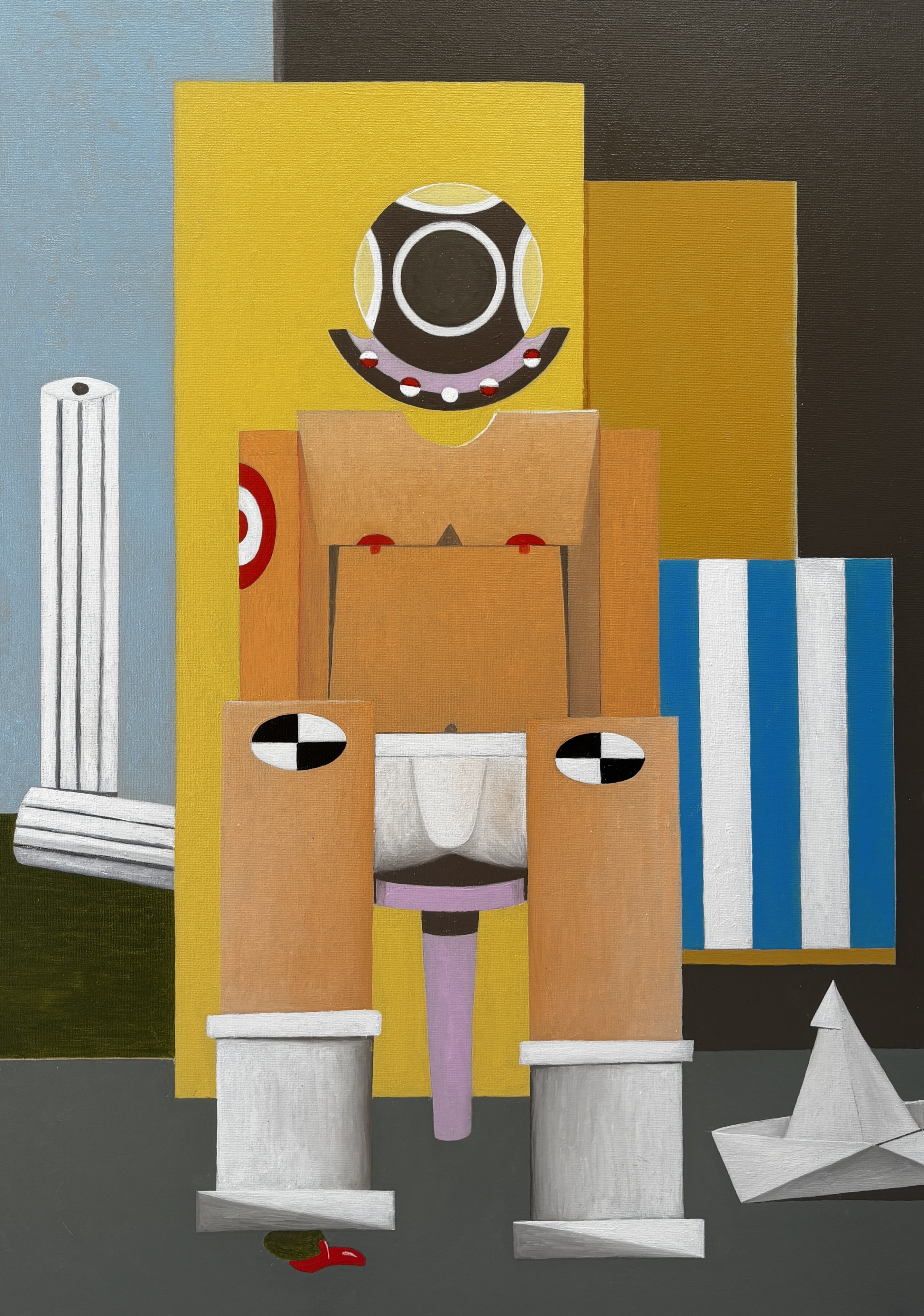
Seated and deprived of clothing, the figure wears the helmet of a diving apparatus and, at its feet, the corresponding boots, with no air supply. The device is connected to no source: the individual depends entirely on the air granted to them. The posture suggests that the hands are tied behind the back. The position of the pectorals indicates a collapse of the torso, a body no longer able to hold itself, submitted to gravity. The absence of a head removes all identity: the body becomes an anonymous unit, without origin or status. The target tattooed on the arm indicates prior designation.
At the feet lies a crushed olive, referring to the fruit of the branch, an ancient symbol of peace and hope. Its crushing, not intentional, evokes the fragility of a symbol threatened yet persistent. The origami boat on the ground represents the flotilla: a fragile structure confronted with superior force.
The boots of the diving apparatus weigh the figure down and hold it to the ground, further reinforcing the impossibility of any movement.The floor, a cold grey, remains neutral; only the stain from the crushed olive inscribes violence into the material.
The organisation of the body into elementary volumes refers to Cubism. The architectonic elements — broken column, rigid verticals, constrained structure — relate to Constructivism. The metaphorical charge of the composition, where each element functions as a sign, aligns with Symbolism.
FR – Les 29 et 30 avril 2026, une flottille humanitaire en route vers Gaza est interceptée en eaux internationales. L’œuvre s’inscrit dans ce contexte d’interruption, de saisie et de neutralisation.
Assise, privée de vêtements, la figure porte le casque d’un scaphandre et, aux pieds, les bottes qui en proviennent, sans aucune alimentation en air. Le dispositif n’est relié à aucune source : l’individu dépend entièrement de l’air qu’on lui accorde. La posture suggère que les mains sont attachées derrière le dos. La position des pectoraux indique un effondrement du torse, un corps qui ne se maintient plus, soumis à la gravité. L’absence de tête supprime toute identité : le corps devient une unité anonyme, sans origine ni statut. La cible tatouée sur le bras indique une désignation préalable.
Aux pieds, une olive écrasée renvoie au fruit du rameau, symbole ancien de paix et d’espoir. Son écrasement, non intentionnel, évoque la fragilité d’un symbole menacé mais persistant. Le bateau origami posé au sol représente la flottille : une structure fragile confrontée à une force supérieure.
Les bottes du scaphandre l’alourdissent et le maintiennent au sol, renforçant encore l’impossibilité de tout mouvement. Le sol, d’un gris froid, reste neutre ; seule la tache issue de l’olive inscrit la violence dans la matière.
L’organisation du corps en volumes élémentaires renvoie au Cubisme. La présence d’éléments architectoniques — colonne brisée, verticales rigides, structure contrainte — s’inscrit dans le Constructivisme. La charge métaphorique de l’ensemble, où chaque élément fonctionne comme un signe, relève du Symbolisme.
LU – Den 29. an 30. Abrëll 2026 gëtt eng humanitär Flottille op hirem Wee op Gaza an internationalen Gewässeren gestoppt an ënner Kontroll gesat. D’Wierk steet an dësem Kontext vu Ënnerbriechung, Sécherstellung an Neutraliséierung.
D’Figur sëtzt, ouni Kleeder, mam Helm vun engem Scaphandre uewen an de Stiwwelen dovun un de Féiss, ouni all Loftversuergung. De System ass un keng Quell ugeschloss: d’Persoun ass komplett op déi zougestane Loft ugewisen. D’Haltung léisst drop schléissen, datt d’Hänn hannert dem Réck fixéiert sinn. D’Positioun vun de Pectoralen weist op en Zesummefall vum Torso hin — e Kierper, deen sech net méi droe kann an der Schwéierkraaft nogëtt. D’Fehle vun engem Kapp hëlt all Identitéit ewech: de Kierper gëtt zu enger anonymer Eenheet, ouni Hierkonft an ouni Status. D’Zilsymbol um Aarm weist op eng virdru festgeluechte Markéierung.
Bei de Féiss läit eng zerdréckte Oliv, déi op de Friicht vum Zweig verweist — e Symbol vu Fridden an Hoffnung. D’Zerdrécke geschitt net aus Wëllen: et weist op d’Fragilitéit vun engem Symbol hin, menacéiert awer bestoen. D’Origami-Boot um Buedem steet fir d’Flottille: eng fragil Struktur, déi enger iwwerleeëner Kraaft géintiwwersteet.
D’Stiwwelen vum Scaphandre beschwéieren d’Figur a halen hatt um Buedem, wat d’Onméiglechkeet vu Bewegung nach weider verstäerkt. De Buedem, a kalem gro, bleift neutral; just d’Fleck vun der zerdréckter Oliv dréit d’Gewalt an d’Material eran.
D’Organisatioun vum Kierper a reduzéierte Volumen erënnert un de Kubismus. D’architektonesch Elementer — gebrach Kolonn, strikt Vertikalen, agegrenzt Struktur — stinn am Geescht vum Konstruktivismus. D’metaphoresch Laascht vum Ganzen, wou all Element als Zeechen funktionéiert, entsprécht dem Symbolismus.

L’interpellé
Dimensions 50×70 cm